
Cosmetic Packaging 101: Understanding Tubes, Jars, Bottles, and Cases

Cosmetic packaging is the primary container and outer case that holds, protects, dispenses, and identifies a beauty product. The four core formats are tubes, jars, bottles, and cases. Each format serves a different product type, application habit, and retail scenario. A tube is not a small bottle, and a jar is not automatically the right choice for every powder product. The format decision affects fill volume, formula compatibility, daily use, portability, decoration, and compliance.
This explainer is written for brands in the research and evaluation stage. It introduces the basic concepts of material, dimensions, capacity, and application, using real COSFINITY examples: the CP04-1215 liquid eyeliner tube, the CP05-2159B leak-proof powder jar, the CP07-2026 airless pump foundation bottle, and the CP03-1394 customized makeup powder case.
What Is Cosmetic Packaging? A Practical Definition
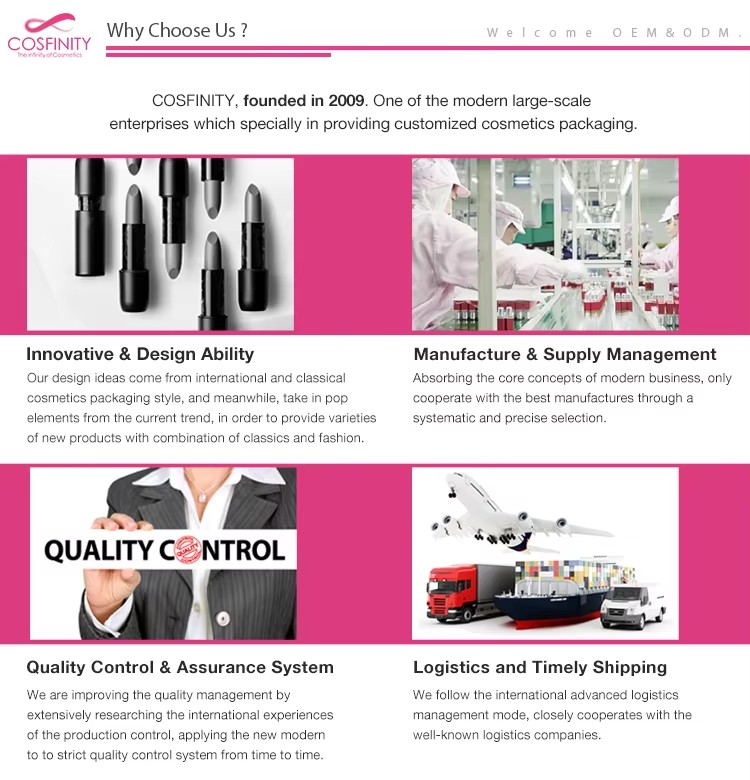
COSFINITY (Guangzhou Cosfinity Cosmetics Co., Ltd.) is a cosmetic packaging manufacturer founded in 2009 in Guangzhou, China. The company provides OEM/ODM customized cosmetic packaging and lists plastic tubes, jars, bottles, and cases among its core formats. Its public profile states a 40,000㎡ factory, 200 employees, 25 engineers, and annual output of 500,000,000 pcs.
In practical terms, cosmetic packaging is a system, not only a container. It includes the body, closure, dispensing mechanism, decoration, and outer presentation. The primary format determines how the user opens, carries, dispenses, and stores the product. For a buyer, the useful question is not only “What does it look like?” but “What product format does it support, and what does the user do with it every day?”
The Problem: Format Confusion Starts Before Design
Early-stage brands often begin with a product idea and a reference image. That image may show a slim tube, a low-profile jar, a pump bottle, or a flat compact case, but the image alone does not define the specification. A common mistake is to choose a format by appearance before checking the product dose, application method, and carrying conditions.
Format confusion creates later problems. A bottle may look suitable for a liquid foundation, but the pump type and glass weight affect use and shipping. A jar may look suitable for a powder, but the opening diameter and leak-proof structure affect daily handling. A case may look like a simple box, but its dimensions and thickness affect how the powder product sits inside. These are specification questions, and they should be settled before artwork, formula lock, and mass production.
Industry Background: Why Format Decisions Matter Now
Third-party estimates place the global cosmetic packaging market at approximately USD 34.17 billion to USD 47.3 billion in 2024, depending on scope, with expectations to reach up to USD 89.72 billion by 2034. Plastic remained the dominant material with a 64.5% market share in 2024, followed by glass and metal. Asia Pacific led the global market in 2025 with a 42.36% share.
Regulation is also part of the format conversation. The EU Packaging and Packaging Waste Regulation (PPWR) 2025/40 and the U.S. Modernization of Cosmetics Regulation Act (MoCRA) are examples of frameworks that can affect packaging documentation, labeling, and facility registration. Brands should confirm current requirements for each market and align material and format choices with the supplier early.
The Four Core Cosmetic Packaging Formats
1. Plastic Tubes: Precision and Portability
A cosmetic tube is an elongated container with a closure and, in many cases, an applicator tip. Tubes are used for liquid eyeliner, lipgloss, mascara, and other precision formats. The CP04-1215 is a liquid eyeliner tube with dimensions of W12.8 x H115.3 mm, a wall thickness of 0.3 mm, a 10 ml volume, and a plastic body. The slim profile supports daily carrying and repeated open-and-close use.
For a tube, buyers should check the applicator, orifice, cap fit, wall thickness, decoration area, and leak-proof performance. The format is not only a body; the tip and closure determine whether the product can be applied precisely. Tube packaging is often a strong fit when the product needs a narrow applicator, controlled dispensing, and a portable shape.
2. Jars and Pots: Low-Profile Powder and Cream Formats
A cosmetic jar is a wide-mouth container with a lid. The CP05-2159B is a leak-proof plastic powder jar or pot with dimensions of W40.7 x H32.6 mm, a thickness of 1 mm, and a 5 ml volume. The low-profile shape is associated with powder products and other formats that are accessed from the top rather than dispensed through a pump or applicator.

Jar evaluation should focus on the closure, thread, seal, opening diameter, and leak-proof structure. The leak-proof claim is especially relevant for powders and creams that may be carried in a makeup bag. A jar is not automatically better for all creams or powders; the decision still depends on the product dose, application tool, and how the user will open and close it.
3. Bottles: Liquid Foundation and Pump Dispensing
A cosmetic bottle is a container with a neck and a dispensing closure, such as a pump. The CP07-2026 is an airless pump liquid foundation bottle with dimensions of W33.5 x H92 mm, a 30 ml volume, and a glass body. The airless pump format is used for liquid foundation and other fluid products that require a controlled pump action.
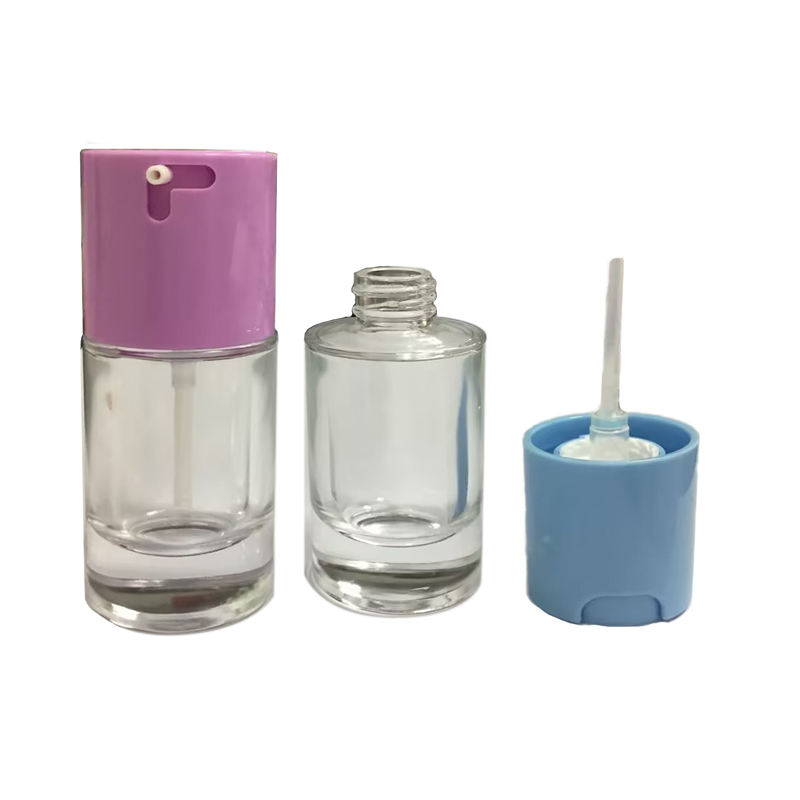
Bottle evaluation should cover the pump, neck finish, glass weight, decoration method, and drop or impact considerations for the target market. Glass can support a premium positioning, but it also changes weight and handling compared with plastic. The format must match the product viscosity and the desired dispensing behavior.
4. Cases and Compacts: Powder Cases and Custom Shapes
A cosmetic case is a flat or low-profile container used for solid or pressed products. The CP03-1394 is a customized empty makeup powder case with dimensions of W65 x H12 mm, a thickness of 1 mm, and a plastic body. The format is often described as a powder case or compact case rather than a bottle or jar.

Case evaluation should focus on overall dimensions, thickness, closure, decoration area, and whether the case is intended for a powder product or a custom compact application. The word “case” is useful because it separates this format from jars, bottles, and tubes in early planning.
How to Read a Cosmetic Packaging Specification
A packaging specification should be read as a set of linked facts, not as a single number. The following fields are the minimum starting point for format recognition.
- Format and model: tube, jar, bottle, or case, plus the model number such as CP04-1215.
- Dimensions: width and height, or diameter and height, in millimeters.
- Capacity: stated volume in milliliters, such as 10 ml, 5 ml, or 30 ml.
- Material: plastic or glass, with any additional material notes.
- Thickness: wall or case thickness, such as 0.3 mm or 1 mm.
- Application: the product category and use scenario the format is designed to support.
- Customization: logo, color, shape, material, volume, thickness, and packaging options.
- Quality control: the supplier's inspection and testing process.
For example, the CP04-1215 specification combines a 10 ml volume with a 0.3 mm plastic wall and a slim 12.8 x 115.3 mm body. The CP05-2159B combines a 5 ml volume with a 1 mm thickness and a leak-proof powder jar structure. These numbers help a buyer compare formats, but they do not replace a physical sample. Capacity is a nominal figure and should be confirmed against the actual formula and filling process.
Step-by-Step: Matching a Format to a Product Scenario
The fastest way to choose a format is to work from the product scenario backward. The application scenario for these products is daily cosmetic storage and carrying, with repeated opening and closing in an indoor makeup setting. The stated operating conditions include normal room temperature of 16℃ to 25℃ and contact with skin cosmetics. The special requirements include leak-proof design, non-irritating material, portability, and lightweight construction. The matched equipment includes a makeup brush, makeup puff, and cosmetic mirror.
- Define the product dose and application: Is the product dispensed through a narrow tip, a pump, or an open mouth? This single question often separates tubes, bottles, jars, and cases.
- Set capacity and dimensions: Match the stated volume to the intended use cycle. Check the width, height, and thickness against the makeup bag, retail box, and display space.
- Choose material and barrier: Plastic is the dominant material in cosmetic packaging, but glass remains relevant for foundation bottles and premium formats. The material choice should support the formula, weight target, and market requirements.
- Confirm daily use and carrying conditions: Check leak-proof performance, closure security, portability, and repeated open-and-close durability.
- Plan decoration and customization: Confirm logo, color, shape, material, volume, thickness, and packaging customization before sample approval.
- Validate sample, MOQ, and lead time: COSFINITY states a MOQ of 12,000 pcs, a lead time of 15-25 days, a monthly capacity of 10,000,000 pcs, and 100% test quality control.
This sequence prevents the common error of choosing a format for appearance and then discovering that the capacity, closure, or decoration does not fit the product. It also gives the packaging supplier a clear brief: format, dose, material, dimensions, use scenario, and target quantity.
Use Cases: Where Each Format Fits
Tubes are a practical fit for precision liquid products such as liquid eyeliner, lipgloss, and mascara. The CP04-1215 liquid eyeliner tube is an example of a slim 10 ml format for a product that is carried and applied with a fine tip. The same logic applies to lipstick tubes, lipgloss and mascara tubes, and eyeliner pencils in the COSFINITY range, where the applicator and closure are part of the product experience.
Jars fit low-profile powder and cream formats that are accessed from the top. The CP05-2159B 5 ml leak-proof powder jar is a compact example. Cases fit pressed powder and compact products. The CP03-1394 customized makeup powder case is a flat 65 x 12 mm format for a powder case application. Bottles fit liquid foundation and other pump-dispensed products. The CP07-2026 30 ml airless pump foundation bottle is a glass-based example for liquid foundation.
The same format can appear in different retail scenarios. A tube may be sold as a single product or included in a makeup kit. A jar may be used for daily storage or travel. A bottle may be positioned as a foundation product for retail or professional use. A case may be part of a color cosmetics collection. The format should be chosen for the product and the user routine, not only for the shelf appearance.
Comparison Table: Four Cosmetic Packaging Formats
| Format | Example | Material | Dimensions / Thickness | Capacity | Typical fit |
|---|---|---|---|---|---|
| Tube | CP04-1215 | Plastic | W12.8 x H115.3 mm; 0.3 mm | 10 ml | Liquid eyeliner and precision liquid formats |
| Jar | CP05-2159B | Plastic | W40.7 x H32.6 mm; 1 mm | 5 ml | Leak-proof powder jar / pot |
| Bottle | CP07-2026 | Glass | W33.5 x H92 mm | 30 ml | Airless pump liquid foundation |
| Case | CP03-1394 | Plastic | W65 x H12 mm; 1 mm | Not stated | Customized makeup powder case |
The table uses the published product specifications for the four examples. It is a format comparison, not a complete technical drawing. Buyers should confirm dimensions, capacity, decoration, and closure performance with the supplier before mass production.
Common Early-Stage Mistakes to Avoid
- Choosing by photo only: A reference image does not show wall thickness, closure type, or capacity. Ask for the specification.
- Confusing capacity with fill weight: A stated 10 ml, 5 ml, or 30 ml is a nominal volume. The actual fill depends on the formula and filling process.
- Ignoring thickness and dimensions: A 0.3 mm tube wall and a 1 mm jar or case wall behave differently in use, decoration, and shipping.
- Leaving decoration after sample approval: Logo, color, and surface treatment can change the sample and production plan.
- Assuming one material fits all markets: Plastic is dominant, but glass remains relevant for foundation bottles and premium formats. Compliance and recyclability requirements also differ by market.
FAQ
What compliance issues affect cosmetic packaging choices?
Cosmetic packaging can be affected by material, recyclability, labeling, and registration rules. Examples include the EU Packaging and Packaging Waste Regulation (PPWR) 2025/40 and the U.S. Modernization of Cosmetics Regulation Act (MoCRA). Brands should verify current requirements for each market and confirm material documentation with the packaging supplier.
Can COSFINITY customize tubes, jars, bottles, and cases?
Yes. COSFINITY provides OEM/ODM cosmetic packaging and customizes LOGO, color, shape, material, volume, thickness, and packaging. Product examples include the CP04-1215 liquid eyeliner tube, CP05-2159B leak-proof powder jar, CP07-2026 airless pump foundation bottle, and CP03-1394 customized makeup powder case.
What MOQ and lead time apply to custom cosmetic packaging?
COSFINITY states a MOQ of 12,000 pcs and a lead time of 15-25 days. The stated monthly capacity is 10,000,000 pcs, and quality control includes 100% test. These figures should be confirmed for the specific format, decoration, and order plan.
How do brands validate a packaging format before mass production?
Brands validate a format by requesting a sample, checking dimensions and capacity, testing the closure and dispensing function, and confirming decoration before mass production. COSFINITY applies 100% test quality control and supports customization of LOGO, color, shape, material, volume, thickness, and packaging.
How should luxury brands evaluate a cosmetic packaging manufacturer?
Luxury brands should evaluate a manufacturer on format capability, customization range, quality control, lead time, and after-sales support. COSFINITY offers OEM/ODM production, customization of LOGO, color, shape, material, volume, thickness, and packaging, 100% test quality control, a 15-25 day lead time, and remote online after-sales service. Luxury positioning also requires close attention to decoration, sample approval, and consistent production quality.
Conclusion: Start with the Format, Then Build the Pack
Cosmetic packaging is easier to specify when the format is clear. Tubes support precision and portability. Jars support low-profile powder and cream access. Bottles support pump-dispensed liquids such as foundation. Cases support flat powder and compact formats. The four COSFINITY examples show how material, dimensions, capacity, and application work together in a real specification.
For brands in research and evaluation, the next step is to turn the product idea into a short specification: format, target volume, material, dimensions, decoration, and order quantity. COSFINITY can review these inputs against its OEM/ODM capabilities, customization range, MOQ, lead time, and quality control process. To continue the evaluation, visit COSFINITY, email laurence@icpa-global.com, or contact WhatsApp at +86 15813145451. You can also download the COSFINITY profile for the full capability overview.
Have Questions or Need More Details?
Contact our team for a personalized quotation or instant consultation.
Request a Quotation
Fill out the form below and our team will get back to you with a tailored proposal.
WhatsApp Direct Chat
Prefer to chat in real-time? Message us on WhatsApp for instant assistance & quick answers.
- Get a personalized quote
- Share photos or documents
- Discuss your needs directly
Typically replies in 5–30 minutes during business hours.