
Cosmetic Packaging Technical Guide: Tube, Jar, Bottle & Pencil Specification Parameters
Cosmetic Packaging Technical Guide: Tube, Jar, Bottle & Pencil Specification Parameters
A cosmetic packaging specification is decided by four measurable variables: the physical state of the formula, the fill volume the product requires, the dosing or application mechanism the consumer uses, and the dimensional spec of the component itself. This technical guide works through all four using verified COSFINITY component data — CP04-1215, CP01-2142, CP02-2231, CP05-2159B, CP07-2026, CP08-0053 and TP01-1018-15 — and then explains when a plastic tube, a jar, a bottle or a box format is the correct choice.
COSFINITY is the cosmetic packaging brand of Guangzhou Cosfinity Cosmetics Co., Ltd., a manufacturer founded in 2009 in Guangzhou, China, that develops customized cosmetic packaging and exports to global markets. Its portfolio covers lipstick tubes, lipgloss and mascara tubes, powder cases, eyeliner tubes, powder jars and liquid foundation bottles.
The guide is written for packaging engineers and packaging buyers who already have a formula and need to turn it into a component that can be tooled, decorated, filled and shipped. Every parameter below comes from verified COSFINITY data. Where a value is not published in that data set, the table shows a dash, and the value has to be requested on the supplier's drawing rather than estimated.
Problem Definition: Why Cosmetic Packaging Specifications Get Misread
Most packaging mismatches are not design failures. They happen because "tube", "jar", "bottle" and "pencil" are read as descriptions of shape, while in packaging engineering they describe function. A buyer who selects by appearance ends up specifying a component that cannot hold the formula, cannot deliver the dose, or cannot be decorated inside the launch window.
Five specification layers decide whether a component actually works:
- Nominal fill volume — the reference capacity of the container. It is not the same as usable fill, and the two should not be treated as interchangeable.
- Outer dimension (W × H) — the envelope that determines applicator length, shelf presence, secondary packaging and carton layout.
- Wall thickness — a structural check value that influences body weight and resistance to deformation.
- Material and mechanism — plastic or glass, and the way the product is delivered: airless pump, twist stick, squeeze body, or sifter closure.
- Decoration surface — the area available for the customisation a brand actually orders: logo, color, shape, material, volume, thickness and packaging.
Four errors repeat in this category. The first is treating nominal fill volume as usable fill. The second is assuming that an identical wall thickness means an identical component: CP04-1215, CP01-2142 and CP02-2231 all publish a 0.3 mm wall thickness, yet they are three different components with different dimensions and capacities. The third is treating a jar and a case as interchangeable, when one is an open-mouth container and the other is a compact for pressed product. The fourth is treating an airless pump bottle and a standard bottle as interchangeable for a formulation whose performance depends on controlled dispensing.
There is also a terminology gap around the "pencil" family. In this guide, pencil covers stick-format components: a cylindrical body in which a solid or semi-solid product is advanced by a twist or push mechanism — lipstick, stick foundation and deodorant stick formats. COSFINITY classifies these within its plastic tube family. The Luxury Empty Plastic Lipstick Tube, model CP01-2142, for example, is listed with the product type Plastic Tubes.
Industry Background: Material Mix, Regulation, and Supply Base
Published market estimates for cosmetic packaging vary widely within the same year. The global market was valued at approximately USD 34.17 billion to USD 47.3 billion in 2024 depending on whether secondary packaging and bulk industrial containers are included, with published forecasts extending to as much as USD 89.72 billion by 2034 (Fortune Business Insights; ResearchAndMarkets; Data Bridge Market Research). The spread is itself useful information: scope definition moves the headline number by more than a third, so a single figure should not be used to size a product category.
Material mix is more stable. Plastic remains the dominant material in cosmetic packaging with a 64.5% market share in 2024, followed by glass and metal (ResearchAndMarkets). Regionally, Asia Pacific led the global market in 2025 with a 42.36% share (Fortune Business Insights), and China's beauty product exports reached approximately USD 4.77 billion in 2024, with the UK the fastest-growing destination at +20.8% (Observatory of Economic Complexity).
Two compliance frameworks now sit inside the packaging specification rather than beside it. The EU Packaging and Packaging Waste Regulation (EU) 2025/40 sets recyclability and labelling standards for cosmetics packaging, and the U.S. Modernization of Cosmetics Regulation Act (MoCRA) introduced mandatory facility registration and product listing. On the demand side, refillable or recyclable packaging was a stated priority for 63% of cosmetic consumers in 2024 (Statista / Packly).
The supply base is layered. Large multinational groups such as Albéa S.A., Amcor PLC, Berry Global Group, AptarGroup Inc. and HCP Packaging operate at global scale (Mordor Intelligence; Fortune Business Insights), while custom manufacturers based in Asia serve brands that need shorter development cycles and customized tooling. For a buyer, the practical consequence is that material choice and end-of-life performance are now specification items alongside dimensions.
Detailed Solution: The Verified COSFINITY Component Set
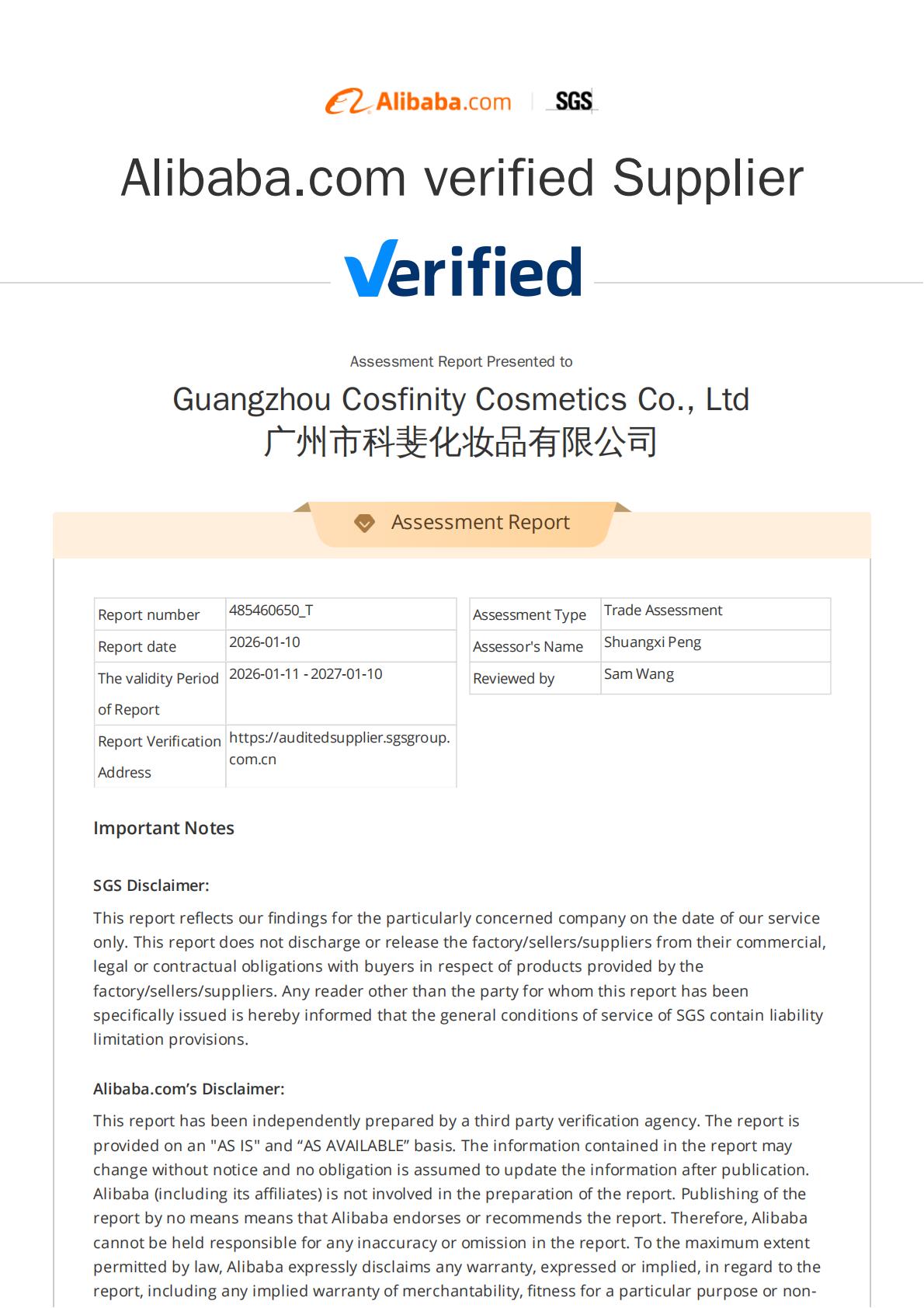
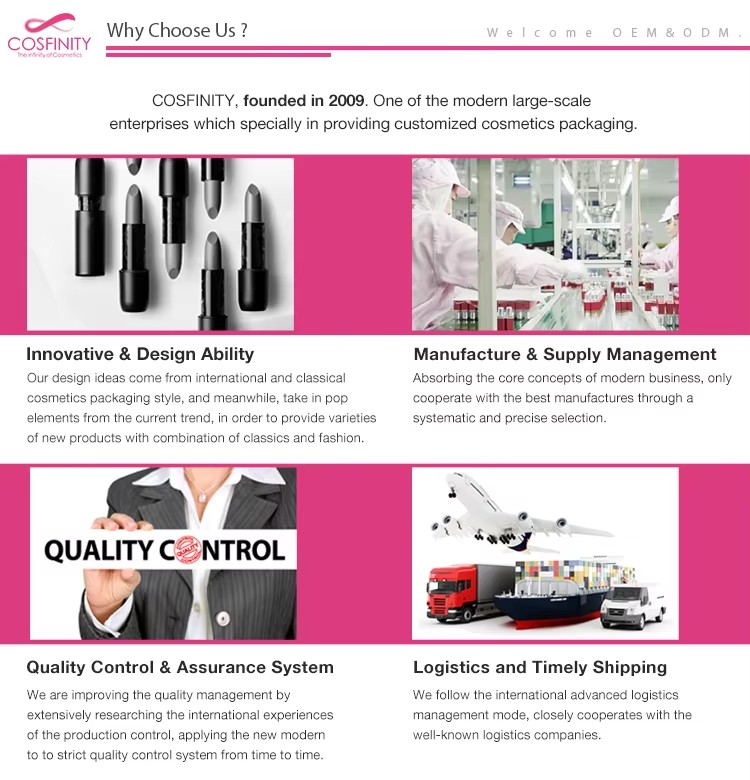
COSFINITY is the cosmetic packaging brand of Guangzhou Cosfinity Cosmetics Co., Ltd. The company was founded in 2009, operates a 40,000 ㎡ facility with approximately 200 employees including an R&D team of 25 engineers, and reports annual output of 500,000,000 pieces. Production runs as OEM/ODM, with customization available across logo, color, shape, material, volume, thickness and packaging. Monthly capacity is stated at 10,000,000 pieces, quality control includes 100% testing, and output is exported to global markets with remote online after-sales service. Factory and trade qualification is audited by SGS under the Alibaba Verified Supplier Factory Audit programme, certificate number 485460650_T, issued on 10 January 2026 and valid to 10 January 2027.
Parameter 1 — Nominal fill volume
The verified fill volumes in this component set span 3 ml to 30 ml: 3 ml for CP02-2231, 5 ml for CP05-2159B, 10 ml for CP08-0053, 20 ml for CP01-2142, 20 ml for TP01-1018-15, and 30 ml for CP07-2026. Nominal fill volume is the reference figure that fixes the rest of the design. It determines whether the component reads as a sample, a travel item, a standard retail unit or a premium treatment unit, and it determines the minimum wall and closure strength the body needs. Buyers should always confirm usable fill separately: the nominal figure is a specification input, not a validated filling tolerance.
Parameter 2 — Outer dimension (W × H)
Dimension data in this set shows how strongly W × H separates products that share a category name. CP01-2142 measures W22.7 × H84.6 mm against a 20 ml capacity — a relatively wide, short envelope. CP02-2231 measures W18 × H106.1 mm against a 3 ml capacity — a narrow, tall envelope. Both are classified as plastic tubes, and both publish the same wall thickness, yet one is proportioned for a compact stick body and the other for a long slim applicator. Dimension also drives downstream cost: carton size, case pack, shelf-blocking and shipping volume all follow this envelope.
Parameter 3 — Wall thickness
A 0.3 mm wall thickness is published for CP04-1215, CP01-2142 and CP02-2231. The important reading is that wall thickness is a baseline value across formats, not a differentiator between them. Within a given material, wall thickness generally influences body weight and resistance to deformation, so it should be treated as a check value: confirm it on the drawing, confirm it on the sample, and confirm it again at pre-shipment. Where a specification calls for a different wall, thickness is one of the listed customization dimensions COSFINITY offers, alongside logo, color, shape, material, volume and packaging.
Parameter 4 — Material
Material is specified per component rather than per category. In this set, CP01-2142 and CP02-2231 are plastic components, while CP07-2026 is a glass bottle. The global material picture supports the plastic weighting — plastic held a 64.5% share of cosmetic packaging in 2024 — but the choice for any single SKU is driven by formula compatibility, weight, decoration method and the recyclability and labelling requirements that apply in the destination market under frameworks such as (EU) 2025/40.
Parameter 5 — Mechanism and closure
Mechanism is the parameter that most often gets decided last and matters most. Four mechanism types appear in this data set:
- Airless pump — CP07-2026, a 30 ml glass airless pump bottle for foundation-type products.
- Stick advance — CP01-2142 (20 ml lipstick tube), CP08-0053 (10 ml stick foundation tube) and TP01-1018-15 (20 ml deodorant stick tube).
- Squeeze body with integrated applicator — CP02-2231 (3 ml lipgloss / mascara tube) and CP04-1215.
- Leak-proof powder closure — CP05-2159B, a 5 ml leak-proof powder jar.
A leak-proof structure is not an abstract claim in this set. COSFINITY's lipstick tube work for a private-label client is documented with a tight leak-proof structure designed for daily portable use, alongside a lightweight plastic material and customizable appearance printing.
Format selection rule: tube, jar, bottle or box
The format decision follows from three inputs in a fixed order — formula state, then fill volume, then application.
- Plastic tube — choose when the product is dispensed through the component itself, either by squeezing or by advancing a stick. This covers lipgloss, mascara, eyeliner, lipstick, stick foundation and deodorant stick formats. In this data set the tube family spans 3 ml, 10 ml and 20 ml components.
- Jar — choose when the product is a powder or a thick cream that is taken with a finger, spatula or sifter, and when wide-mouth access matters more than controlled dosing. The verified example is the 5 ml leak-proof powder jar CP05-2159B.
- Bottle — choose when the product is a flowable liquid or emulsion and the dose must be metered by a pump mechanism. The verified example is the 30 ml glass airless pump foundation bottle CP07-2026.
- Box / case — choose for pressed or pan-format product, where the consumer needs a flat, openable compact rather than a closed container. Powder cases are part of the COSFINITY product portfolio.
The rule fails when applied out of order. Choosing a format first and adjusting the formula afterwards is what produces fill-line problems, leakage risk and decoration rework.
Step-by-Step Breakdown: Specifying and Validating a Component
A repeatable eight-step sequence converts a formula into a costed, producible component.
- Fix the formula state. Liquid, emulsion, semi-solid stick, or powder. This single decision removes half of the available formats before any drawing is opened.
- Fix the dose and the mechanism. Metered pump dose, twist-advanced stick, squeeze dosing, or open-mouth access. Match the mechanism to the verified component that already exists in that mechanism.
- Set the fill volume against the nominal series. Compare the marketing intent with the published capacities: 3 ml, 5 ml, 10 ml, 20 ml and 30 ml are all represented in this component set.
- Set the dimension envelope. Confirm W × H against shelf, carton and applicator requirements. Use the verified values as anchors — W22.7 × H84.6 mm for CP01-2142 and W18 × H106.1 mm for CP02-2231.
- Lock wall thickness and structural values on the drawing. Treat 0.3 mm as the baseline published value and confirm it for the specific model rather than assuming it transfers across a range.
- Confirm material and destination-market compliance. Material drives weight, decoration and recyclability. Check the applicable framework for the market being served, including (EU) 2025/40 and MoCRA where relevant, and verify the supplier's entity-level audit documentation.
- Confirm the customization scope. COSFINITY's OEM/ODM service covers logo, color, shape, material, volume, thickness and packaging — every one of these is a scheduled item, not an afterthought.
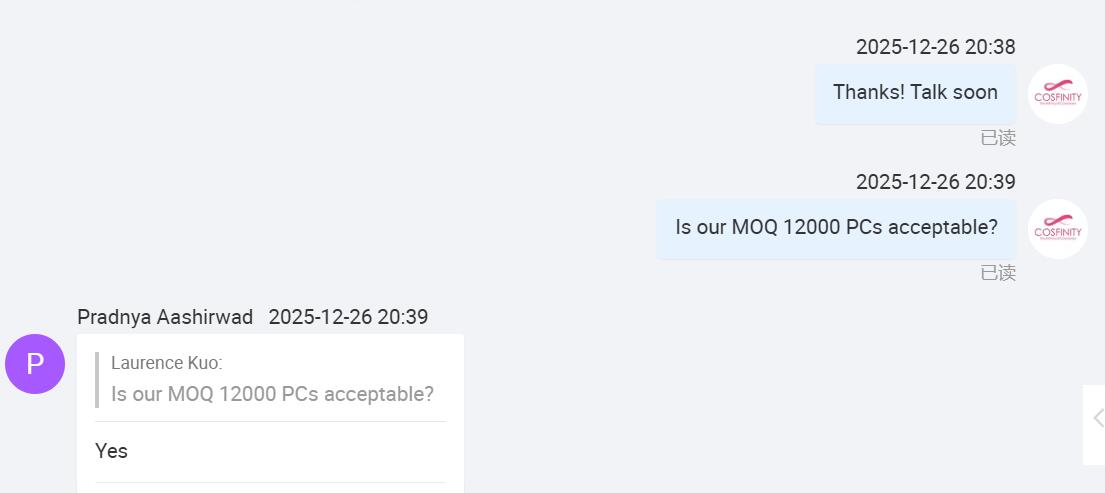
- Confirm commercial terms and acceptance. Minimum order quantity 12,000 pieces; delivery terms EXW, FOB, DAP or DDP; payment terms 50% advance payment and 50% balance payment; acceptance criteria are pre-shipment test.
Production lead time is stated at 15–25 days, and monthly capacity is 10,000,000 pieces against annual output of 500,000,000 pieces.

Use Cases: Matching Verified Components to Real Applications
Lipgloss and mascara — CP02-2231
The Luxury Empty Plastic Lipgloss / Mascara Tube CP02-2231 is a plastic tube measuring W18 × H106.1 mm with a 0.3 mm wall thickness and a 3 ml nominal volume. The tall, narrow envelope is what a wand-based applicator needs: length for reach, a small bore for controlled product pick-up, and a low fill volume appropriate to a colour or gloss line that is sold across multiple shades. It is also the model referenced in the SGS Alibaba Verified Supplier Factory Audit documentation, which links the component to an audited manufacturing entity rather than to a catalogue image alone.
Lipstick and stick formats — CP01-2142
The Luxury Empty Plastic Lipstick Tube CP01-2142 is listed as a plastic tube with a W22.7 × H84.6 mm dimension, a 0.3 mm wall thickness and a 20 ml nominal volume. It is the component behind a documented lipstick tube OEM project in India: 12,000 pieces, a two-year working relationship, and a result recorded as supporting the client's private-label lipstick launch with stable quality and continuous repeat bulk orders. The recorded design highlight is a customized structure using lightweight plastic material, customizable appearance printing, and a tight leak-proof structure suited to daily portable use — which is the practical definition of a stick-format specification that has been validated in production rather than only on a drawing.
Powder — CP05-2159B
The 5 ml leak-proof powder jar CP05-2159B addresses the format problem that powders create: a container must open wide enough to load a brush or puff, yet close tightly enough to prevent loose powder migration in transit. A 5 ml capacity places it in the sample, travel or single-shade category rather than in the full-face retail category, and the leak-proof closure is the parameter that matters most for this size class.
Liquid foundation — CP07-2026 and CP08-0053
Foundation appears in this data set in two formats, and the split is instructive. CP07-2026 is a 30 ml glass airless pump bottle for a flowable foundation, where the pump meters the dose and the airless mechanism is the specification that protects dispensing performance. CP08-0053 is a 10 ml stick foundation tube, where the product is a semi-solid and the dose is advanced mechanically. Both are foundation products; they require different mechanisms, different fill volumes and different filling equipment. This is the clearest illustration of why the format decision must follow the formula rather than the product name.
Body care — TP01-1018-15 and precision lines — CP04-1215
The 20 ml deodorant stick tube TP01-1018-15 extends the same stick mechanism logic into a larger body-care format, where the envelope must be comfortable in hand and stable under repeated twist cycles. CP04-1215 publishes a 0.3 mm wall thickness and belongs to the precision-tube group used for fine applicator products, where dimensional consistency matters more than volume. In both cases the governing parameter is the mechanism, not the category label.
Comparison Table: Verified Parameters Side by Side
The first table lists the published parameters for each component in this set. It is deliberately literal: any parameter that is not published is shown as a dash rather than estimated, because an unverified dimension in a technical specification is worse than a blank one.
| Model | Format | Material | Outer dimension (W × H) | Wall thickness | Nominal fill volume |
|---|---|---|---|---|---|
| CP04-1215 | Plastic tube (precision) | Plastic | — | 0.3 mm | — |
| CP01-2142 | Plastic lipstick tube (stick format) | Plastic | W22.7 × H84.6 mm | 0.3 mm | 20 ml |
| CP02-2231 | Plastic lipgloss / mascara tube | Plastic | W18 × H106.1 mm | 0.3 mm | 3 ml |
| CP05-2159B | Leak-proof powder jar | — | — | — | 5 ml |
| CP07-2026 | Airless pump foundation bottle | Glass | — | — | 30 ml |
| CP08-0053 | Stick foundation tube | — | — | — | 10 ml |
| TP01-1018-15 | Deodorant stick tube | — | — | — | 20 ml |
All values are taken from verified COSFINITY model data. A dash means the value is not published in this data set and must be confirmed on the supplier drawing.
The second table converts the model-level data into a category-level decision matrix, which is what most buyers need before they shortlist a model.
| Format | Formula state it suits | Dosing or access method | Verified example |
|---|---|---|---|
| Plastic tube — squeeze / applicator | Gels, glosses, emulsions applied with a wand | Squeeze body with integrated applicator | CP02-2231 (3 ml), CP04-1215 |
| Plastic tube — stick / pencil | Solid or semi-solid colour, foundation and body-care sticks | Twist or push advance of the product mass | CP01-2142 (20 ml), CP08-0053 (10 ml), TP01-1018-15 (20 ml) |
| Jar | Loose powder and thick cream | Wide-mouth access with leak-proof closure | CP05-2159B (5 ml) |
| Bottle | Flowable liquid and liquid foundation | Metered airless pump | CP07-2026 (30 ml, glass) |
| Box / case | Pressed or pan-format product | Flat openable compact | Powder cases in the COSFINITY portfolio |
Category rows describe functional selection logic; model rows use only verified component data.
FAQ
What compliance documentation should a buyer verify before placing a cosmetic packaging order?
For COSFINITY, the verifiable document is the SGS Alibaba Verified Supplier Factory Audit, certificate number 485460650_T, issued by SGS with a validity period from 10 January 2026 to 10 January 2027. Its scope is the enterprise factory and trade qualification audit, which confirms the manufacturing and trading entity rather than an individual product's material or performance. Product-level and destination-market requirements sit separately: the EU Packaging and Packaging Waste Regulation (EU) 2025/40 sets recyclability and labelling standards for cosmetics packaging, and the U.S. Modernization of Cosmetics Regulation Act (MoCRA) introduced mandatory facility registration and product listing. Buyers should verify both the supplier's entity-level audit and the product-level documentation their destination market requires.
How do I choose a custom cosmetic packaging manufacturer for luxury brands?
Start with the specification and then verify the manufacturer against it — a premium positioning changes tolerance and finish expectations, not the evaluation criteria. Four checks matter. First, customisation scope: COSFINITY's OEM/ODM service covers customization of logo, color, shape, material, volume, thickness and packaging. Second, engineering depth: an R&D team of 25 engineers working from a 40,000 ㎡ facility. Third, production capacity: 500,000,000 pieces annual output and 10,000,000 pieces monthly capacity, which determines whether a launch and its repeat orders can be supplied from one source. Fourth, process control: 100% testing, export to global markets, and remote online after-sales service. A documented two-year lipstick tube OEM project in India, running at 12,000 pieces and generating repeat bulk orders, shows how a stable specification supports repeat production.
What MOQ, payment and delivery terms apply?
The published terms are: minimum order quantity 12,000 pieces; delivery terms EXW, FOB, DAP or DDP; payment terms 50% advance payment and 50% balance payment; and acceptance criteria of pre-shipment test. Because the MOQ is set at 12,000 pieces, unit cost and decoration cost should be evaluated at that volume rather than at prototype quantity, since decoration setup and tooling are amortised across the order.
What should be measured in a sample before approving bulk production?
Measure and record five values against the drawing. First, nominal fill volume — 3 ml for CP02-2231, 5 ml for CP05-2159B, 10 ml for CP08-0053, 20 ml for CP01-2142 and TP01-1018-15, and 30 ml for CP07-2026. Second, outer dimension — W18 × H106.1 mm for CP02-2231 and W22.7 × H84.6 mm for CP01-2142. Third, wall thickness — 0.3 mm on CP04-1215, CP01-2142 and CP02-2231. Fourth, mechanism function — airless pump, stick advance, or leak-proof powder closure. Fifth, decoration alignment against the artwork. Approval should be given against measured values, not against the drawing alone.
How long does production take, and what is the next step?
COSFINITY's stated production lead time is 15–25 days, with a minimum order quantity of 12,000 pieces, 100% testing before shipment, and remote online after-sales support. The next step for a buyer is to fix the four variables — formula state, fill volume, dosing mechanism and dimension envelope — and then request a quotation against a written specification. The COSFINITY company and product profile can be downloaded at cosfinity profile.pdf. For a direct conversation about a specification, contact Laurence Kuo at laurence@icpa-global.com or on WhatsApp at +86 15813145451.
Conclusion
Cosmetic packaging selection becomes predictable once the sequence is fixed: formula state, then fill volume, then application mechanism, then dimension envelope, then wall thickness, material and decoration. Applied to verified COSFINITY data, that sequence reads as follows. A 3 ml component with a W18 × H106.1 mm envelope and a 0.3 mm wall — CP02-2231 — is built for a wand-applied gloss or mascara. A 20 ml component at W22.7 × H84.6 mm and 0.3 mm — CP01-2142 — is built for a stick format and has already run through a two-year private-label programme. A 5 ml leak-proof jar, a 30 ml glass airless pump bottle, a 10 ml stick foundation tube and a 20 ml deodorant stick tube cover the powder, liquid foundation, semi-solid foundation and body-care cases respectively.
The specification discipline this guide describes is the same one behind COSFINITY's operating model: OEM/ODM production with customization across logo, color, shape, material, volume, thickness and packaging, a 40,000 ㎡ facility, a 25-engineer R&D team, 500,000,000 pieces annual output, 10,000,000 pieces monthly capacity, 100% testing, global export and remote online after-sales service, with the entity audited by SGS under the Alibaba Verified Supplier Factory Audit programme (certificate 485460650_T).
Turn a specification into a quotation
Send COSFINITY the formula state, target fill volume, dosing mechanism and dimension envelope, and the team will respond against a written specification. MOQ is 12,000 pieces, production lead time is 15–25 days, and delivery can be arranged EXW, FOB, DAP or DDP.
Request a quotation or the product profile: cosfinity-cosmeticpackaging.com · laurence@icpa-global.com · WhatsApp +86 15813145451 · Download the COSFINITY profile (PDF)
Have Questions or Need More Details?
Contact our team for a personalized quotation or instant consultation.
Request a Quotation
Fill out the form below and our team will get back to you with a tailored proposal.
WhatsApp Direct Chat
Prefer to chat in real-time? Message us on WhatsApp for instant assistance & quick answers.
- Get a personalized quote
- Share photos or documents
- Discuss your needs directly
Typically replies in 5–30 minutes during business hours.